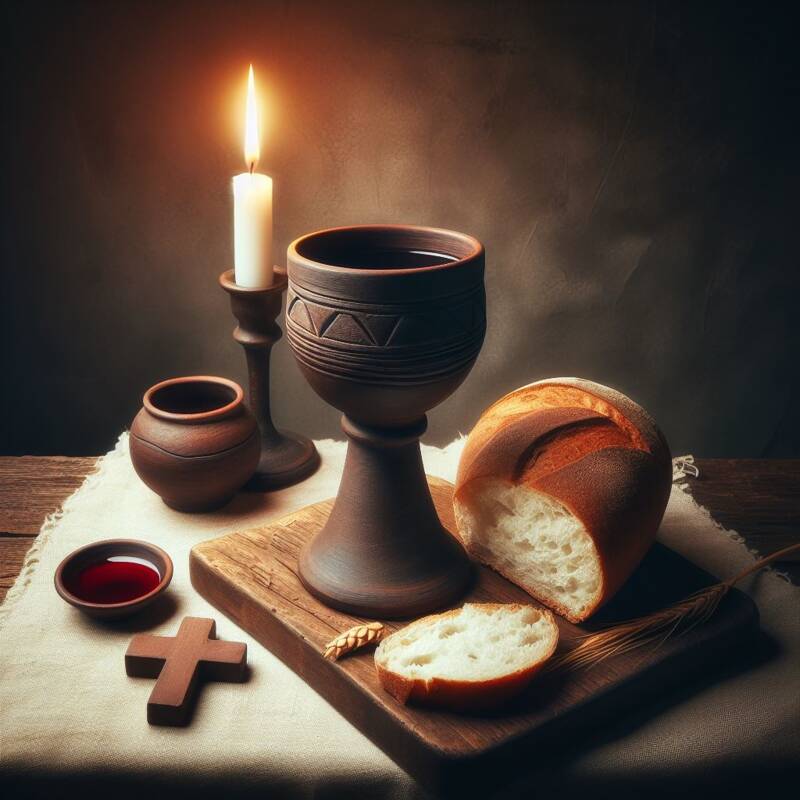
(Sermon at Huntley Community Covenant Church, 11/1/2026)
So, it seems kind of odd, but in the two years I’ve been preaching here, this is the first time we are sharing communion together. I’ve administered communion before, but this is the first time here, so I thought it would be good to talk about and explore this sacrament and what it means.
I don’t know why it was the first thing I wanted to research, but I knew the Catholic Church refers to what we call “communion” as “The Eucharist” so I looked that up and found out it’s a Latin word that means, “gratitude” or “thanksgiving.”
I did not know that, but I think that’s excellent.
But let’s back up and start at the beginning –which is really the middle– but I’ll come back to that.
About two years into His ministry, in other words a year before He was crucified, Jesus fed the 5,000 with only five barley loaves and two fish. The next day, crowd got in boats and found Him on the other side of the lake because they wanted more bread, but He had this conversation with them where He repeatedly said the Father had given them bread (manna) in the wilderness and now He was the bread of life and, well, here’s John 6:53-57
So Jesus said again, “I tell you the truth, unless you eat the flesh of the Son of Man and drink his blood, you cannot have eternal life within you. But anyone who eats my flesh and drinks my blood has eternal life, and I will raise that person at the last day. For my flesh is true food, and my blood is true drink. Anyone who eats my flesh and drinks my blood remains in me, and I in him. I live because of the living Father who sent me; in the same way, anyone who feeds on me will live because of me.”
This was such a hard teaching to buy into, many people stopped following Him. Even His disciples questioned this because it was so radical. Without knowing what we know now, I’m sure it would have seemed beyond weird. This is the point where Peter says, “Lord, to whom shall we go? You have the words of eternal life.”
When Jesus instituted the Lord’s Supper, about a year after that, the light bulbs should have come on. It’s described in Matthew, Mark, and Luke and all three accounts are remarkably similar. Here’s what it says in Matthew 26: 26-29.
“As they were eating, Jesus took some bread and blessed it. Then he broke it in pieces and gave it to the disciples, saying, “Take this and eat it, for this is my body.” And he took a cup of wine and gave thanks to God for it. He gave it to them and said, “Each of you drink from it, for this is my blood, which confirms the covenant between God and his people. It is poured out as a sacrifice to forgive the sins of many. Mark my words—I will not drink wine again until the day I drink it new with you in my Father’s Kingdom.”
The verse most pastors speak when administering communion actually come, not from the gospels, but from Paul writing about it in 1 Corinthians 11:23b-26:
“On the night when he was betrayed, the Lord Jesus took some bread and gave thanks to God for it. Then he broke it in pieces and said, “This is my body, which is given for you. Do this in remembrance of me.” In the same way, he took the cup of wine after supper, saying, “This cup is the new covenant between God and his people—an agreement confirmed with my blood. Do this in remembrance of me as often as you drink it.” For every time you eat this bread and drink this cup, you are announcing the Lord’s death until he comes again.”
I’m sure none of that is unfamiliar to you. We’ve all heard those verses before. And, I could spend a bunch of time on whether the bread and wine are actually transformed into Christ’s body and blood (which is called “transubstantiation” and requires a whole lot of spell check to type correctly) or whether the elements are merely symbolic, but I’m not going there.
Back when I was an elder in the Missouri Synod Church, (which does believe in transubstantiation) there was a Sunday where I was asked to pour the Mogan David into the little cups and prepare those little tasteless white disks for communion. Now, after the service was over, I knew enough to put the little disks that didn’t get used back in the wrapper, but what to do with the wine that went unused? I asked the pastor what I should do with it and he said, “Oh, you can drink it or just pour it down the drain.”
Now, I’ve told you that I had a problem with alcohol many years ago, but the little cup with half an ounce of Mogan David never tempted me to backslide. Still, I sure didn’t want to be standing in the back of the sanctuary guzzling the leftover wine … and the idea of pouring Jesus’ actual blood down the drain seemed really, really disrespectful to our Lord and Savior, but I did it.
So, if I can’t really swallow the whole “transubstantiation” thing (pun intended) does that mean I’m saying the elements are “merely” symbolic?
Let’s put a pin in that for a bit. I will come back to it, but before I do, there are a couple of things that jump out at me in the verses about communion.
Number one is that Jesus said the wine, the blood, confirms the new covenant. A blood covenant in the Bible is a solemn, unbreakable agreement or kinship bond sealed through the shedding of blood, symbolizing total devotion, life surrender, and shared identity under the penalty of death.
The blood covenant is first described in Genesis 15 when God makes a covenant with Abraham and passes between pieces of a bunch of animals Abraham has sacrificed and cut into pieces.
God enters into yet another blood covenant in Exodus 24 when Moses sprinkles the blood of sacrificial animals on the altar and on the people at Mount Sinai when God gives the Law.
So, when we take communion and drink that wine in remembrance of the New Covenant, we are affirming that the blood of Jesus no longer makes it necessary to sacrifice animals to be cleansed of our sins.
The Bible says there is no forgiveness of sins without the shedding of blood, as it says in Hebrews 9:22… which goes back to both of the previous references and originates in Genesis 4:10 when Cain killed Abel and God said, “Listen! Your brother’s blood cries out to me from the ground!”
The glorious thing about the blood of Jesus is that it is and was a once and for all thing. Under the old covenant, you could sacrifice a goat or whatever and your sins would be forgiven – until the next time you sinned.
Jesus, the perfect sacrifice, the spotless Lamb of God has made the New Covenant in Him possible. We no longer have to kill bulls and heifers, goats, rams, turtledoves, pigeons or any other animal and bring the blood before the LORD! And His blood covers all sins, past, present, and future!
HALLELUJAH!
The other thing that jumps off the page at me is when Jesus said, “Mark my words—I will not drink wine again until the day I drink it new with you in my Father’s Kingdom.”
That reads to me like there is eating and drinking in heaven!
And there’s not just one verse that talks about that, in fact all throughout Jesus ministry, there is this recurring theme of His table ministry.
In Luke 5, after Jesus calls Matthew to be a disciple, and this what we see in verses 29 and 30:
“Later, Levi held a banquet in his home with Jesus as the guest of honor. Many of Levi’s fellow tax collectors and other guests also ate with them. But the Pharisees and their teachers of religious law complained bitterly to Jesus’ disciples, “Why do you eat and drink with such scum?“ (NLT)
This is the verse that got me hooked on the New Living Translation. That last word, “scum” in every other translation uses “sinners” or “notorious sinners.” The actual Greek word used is “hamartolon” and it means “sinning, sinful, depraved, detestable” so “scum” is an absolutely legit way to translate that. The Pharisees were disgusted by who got to sit at the table with Jesus, because they loved being the religious big shots.
In Luke 7:36 -50, Jesus dines at the home of Simon the Pharisee and a woman with a sinful reputation washes His feet with her tears. Simon is shocked by this but Jesus tells him she has treated Him better than he has and her sins are forgiven.
In Luke 10:38-42, Jesus visits the home of Mary and Martha for a meal and makes it clear that the spiritual takes priority over the physical.
In Luke 14:12-14, Jesus talks about who to invite to the table, saying, “"When you give a banquet, invite the poor, the crippled, the lame, the blind, and you will be blessed."
In Luke 19: 1-10, Jesus invites Himself to eat with Zacchaeus the tax collector, and says “...salvation has come to this house today."
Then, in Luke 22:29-30, right after he institutes the Lord’s Supper, Jesus says,
“And just as my Father has granted me a Kingdom, I now grant you the right to eat and drink at my table in my Kingdom. And you will sit on thrones, judging the twelve tribes of Israel.”
And, there it is. You and I may not sit on thrones judging the twelve tribes of Israel, but scholars agree that this verse means we will sit at the table and eat and drink with Jesus in heaven!
But, again, let’s not build a whole theology on one verse. Remember what Jesus said in Revelation 3:20?
“Look! I stand at the door and knock. If you hear my voice and open the door, I will come in, and we will share a meal together as friends.”
That’s a “Wow” verse.
And one of my faves from Psalm 23:5&6:
Add comment
Comments